
It is best for a deep question about yourself or the direction of your life, the kind of question you lay out once in a while and then sit with for a few days. Once you know its shape, it is one of the most orderly spreads there is.
Where it comes from
The Tree of Life is a diagram from the Kabbalah: ten spheres, each called a sephirah (the plural is sephiroth), joined by twenty two paths. In the 1850s, in his Dogme et Rituel de la Haute Magie, the French occultist Eliphas Lévi set the twenty two Major Arcana against the twenty two letters of the Hebrew alphabet. The Hermetic Order of the Golden Dawn, founded in London in 1888, built on that link and made the cards keys to the Tree.
The Golden Dawn's own great divination method, the Opening of the Key, finishes with a stage in which the cards are dealt into ten packs in the form of the Tree of Life. That stage used the whole deck. I could not find who first laid the simpler version on this page, one card for each sephirah.
The layout
The Tree stands on three pillars. As you look at the spread, the right hand pillar is Mercy, the left hand pillar is Severity, and the middle pillar, the pillar of Mildness, or Equilibrium, holds the balance between them.
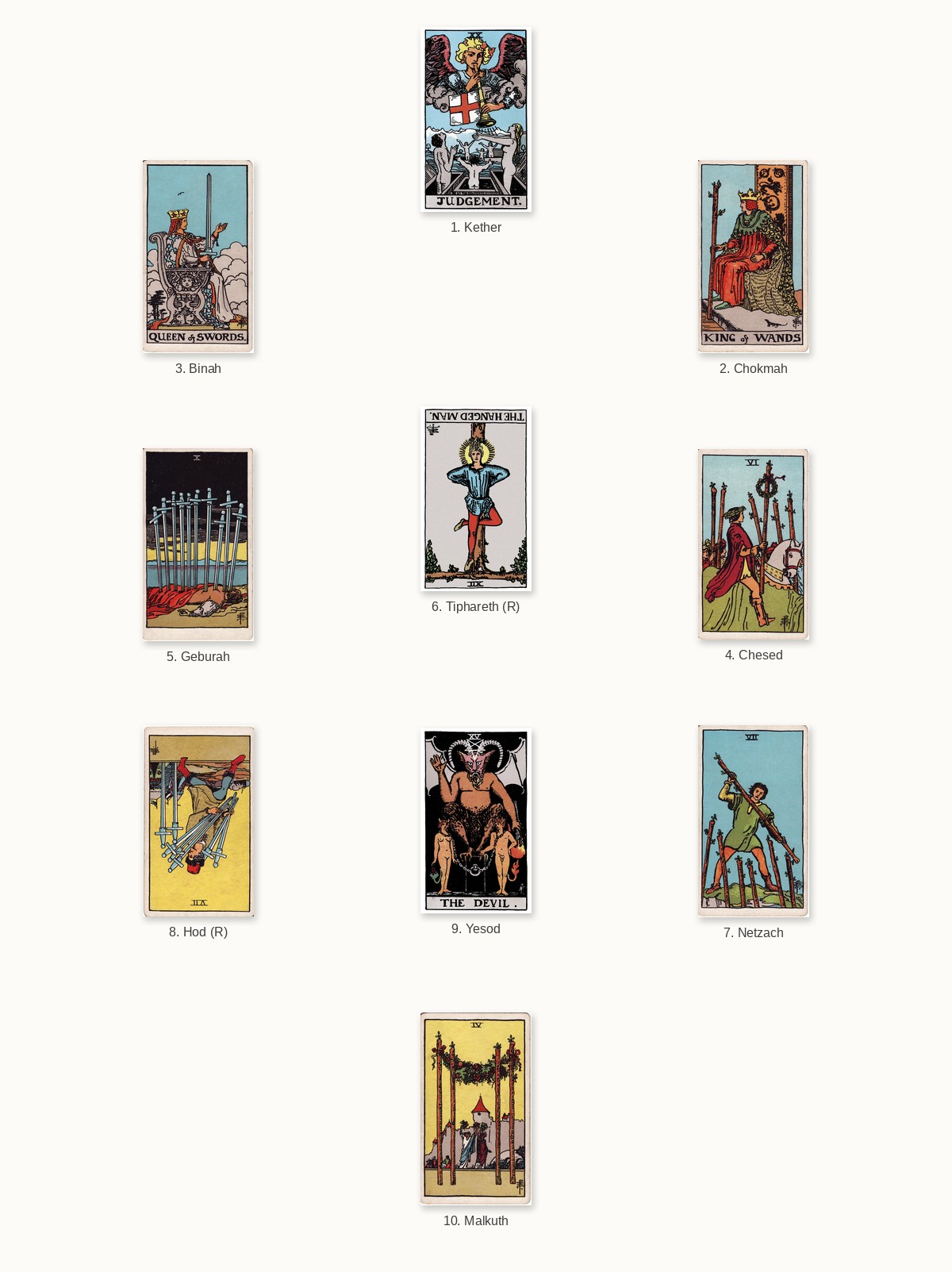
Lay the cards from the top down. Cards 1, 6, 9 and 10 run down the middle pillar, with card 1 at the top and card 10 at the bottom. Cards 2, 4 and 7 go on the right, and cards 3, 5 and 8 on the left, so that 2 and 3, 4 and 5, and 7 and 8 sit level with each other in pairs.
-
Kether, the Crown. The highest aim. The deepest purpose behind the question.
-
Chokmah, Wisdom. The first spark of force. What drives you, the energy that sets things going.
-
Binah, Understanding. Form and shape. What gives that force its limits, and what you understand about the situation.
-
Chesed, Mercy. Growth and generosity. What is being given to you, or what is expanding. Some books call it Kindness.
-
Geburah, Severity. What has to be cut away. Discipline, limits, the necessary ending. Some books call it Strength.
-
Tiphareth, Beauty. The heart of the matter. It sits at the centre, where everything above and below comes into balance.
-
Netzach, Victory. Feelings and desire. What you want, and the drive to go after it.
-
Hod, Splendour. The mind. Thinking, words, plans, the stories you tell yourself. Some books call it Glory.
-
Yesod, Foundation. What runs underneath. Dreams, habits, and patterns you may not be aware of.
-
Malkuth, the Kingdom. The everyday world. Where it all lands: home, body, work and money.
Some diagrams of the Tree show an eleventh, hidden sphere called Daath. The spread leaves it out.
How to read it
Read down the tree first, from the idea at the top to the place it lands at the bottom.
Then read the pillars. The right hand pillar, cards 2, 4 and 7, is what expands, gives and pushes forward. The left hand pillar, cards 3, 5 and 8, is what shapes, restricts and defines. If one pillar is crowded with Majors or heavy with a single suit, the question tips towards it.
Then read across the tree in pairs: 2 and 3, 4 and 5, 7 and 8. Each pair is a force and the form that holds it, from the highest level down to the most personal.
Read the middle pillar last, cards 1, 6, 9 and 10, as a single sentence: purpose, heart, habit, daily life.
Reversed cards follow their sephirah. In Geburah a reversal is often too much or too little, the cut too harsh or never made. In Yesod it is often turned inward, and in Malkuth delayed. A heavy card anywhere on the tree is a mirror.
A sample reading
The question: "What is the next stage of my working life asking of me?" The ten cards are the ones in the sample spread above.
Look at the pillars first. The right hand pillar is all Wands and the left hand pillar is all Swords. Force here is fire and form is air: strong drive, sharp thinking, and the two will need to agree. All three Majors sit on the middle pillar, so the weight of this question runs straight down the centre of the person.
At the crown is Judgement: an angel blowing a trumpet while figures rise from their coffins with arms raised. The highest aim is to answer a call that has been sounding for a while.
Cards 2 and 3. The King of Wands sits holding a flowering staff, a leader with a vision. The Queen of Swords sits in profile with her sword upright and one hand raised, seeing clearly and setting firm edges. Both are mature court cards, so whatever comes next asks this person to lead from experience.
Cards 4 and 5. In Chesed, the Six of Wands: a rider wearing a laurel wreath with a crowd walking beside him. Recognition, earned. In Geburah, the Ten of Swords: a figure lying face down with ten swords in his back, and a strip of light breaking along the horizon. What needs cutting away is already finished, and this card is as far down as things go. The recognition is there, and so is the end of an old role with nothing more to give.
Card 6, the heart of the tree, is the Hanged Man reversed. Upright he hangs by one foot from a living tree, calm, a halo around his head. Surrender, a pause, a new angle. Reversed, I read him as too much: the pause has gone on longer than it needed to, and this person is still hanging there after the time to come down has arrived. That is the centre of the reading.
Cards 7 and 8. In Netzach, the Seven of Wands: a man on high ground fending off six staves raised from below. The feelings are defending what he has. In Hod, the Seven of Swords reversed: upright, a man tiptoes away from a camp with five swords in his arms. Reversed, I read it as turned inward, the strategy aimed at himself. The mind is quietly talking him out of the move.
Card 9, Yesod, is the Devil: two figures chained beneath a horned figure on a black block. Here it is a habit so old it feels like part of the furniture, perhaps the comfort of a familiar role, and it is a mirror showing what keeps the Hanged Man hanging.
Card 10, Malkuth, is the Four of Wands: four staves hung with a garland and a castle behind. Celebration and a stable home: in daily life, the ground is ready.
Now the middle pillar as one sentence: a call has sounded, the pause has gone on too long, an old habit is holding it in place, and there is solid, happy ground waiting once the step is taken.
Variations
-
The middle pillar only. Lay four cards, on Kether, Tiphareth, Yesod and Malkuth, for a short reading that keeps the shape of the tree.
-
Majors only. Shuffle the twenty two Major Arcana on their own and lay the ten from them. The reading comes out larger in scale, which suits a question about the direction of a whole life.
Try it yourself
Lay the tree and read only the middle pillar first, the four cards from top to bottom, as one sentence. Write it down.
Then read the two side pillars and ask whether they explain your sentence. Usually one pushes and the other holds back, and that tension is where the question came from.
If you would like the cards read against your own chart, my readings are here.
Related pages
The Sephiroth