
It is the smallest spread in tarot and the one you will probably use most. A daily card, a focus for a question, a picture to carry around with you for a week. If you have tried the one card a day exercise on the Learning Tarot page, you have already been using it.
With only one card on the table, there is nowhere for the answer to hide. There is no partner card to soften it and no neighbour to lean on. Whatever comes up carries the whole reading by itself, and that makes the single card the best teacher in the deck.
Where it comes from
Nobody knows who first drew a single card and called it a reading. It has no author and no founding book. It is simply the shortest way to put a question to the deck, and in a sense it sits underneath every larger spread, because every spread is one card drawn several times over, each with its own question.
The layout
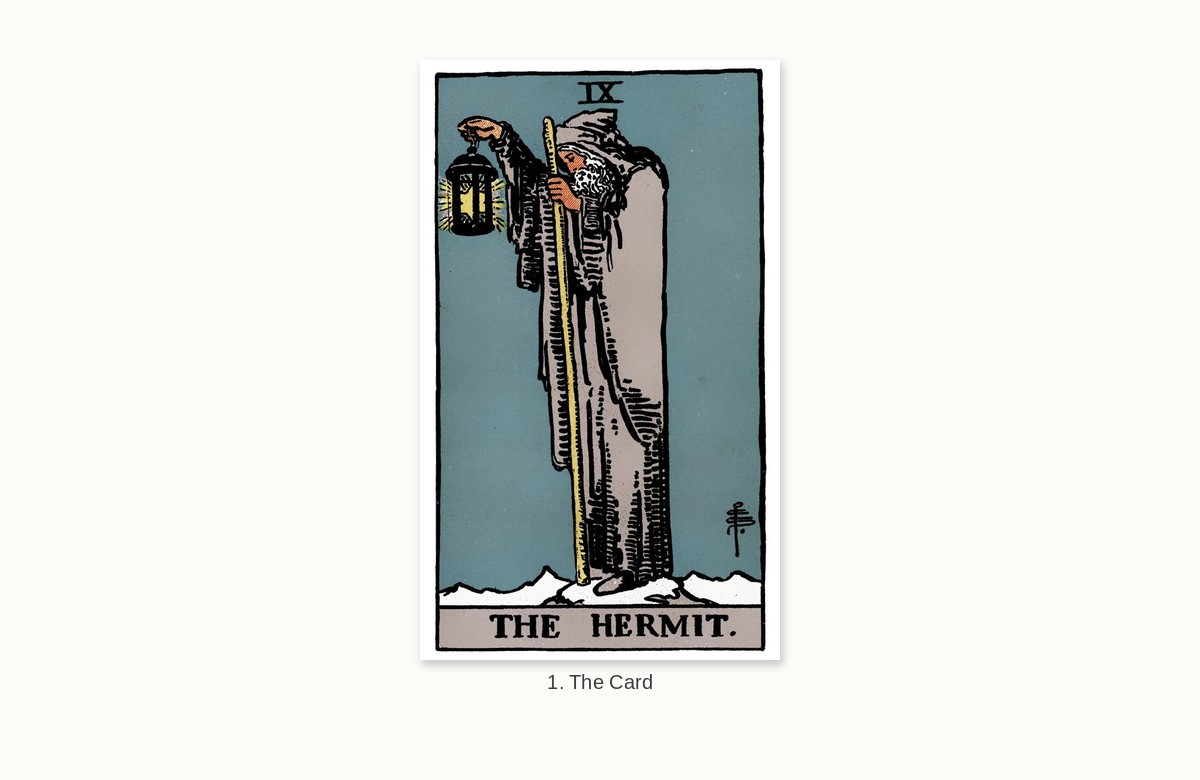
- The Card. The answer to the question you asked, or the theme of the day, the week or the matter you are holding in mind. It stands alone and speaks for the whole question.
The position is whatever your question makes it, so settle the question before you shuffle. "What do I need to know about today?" makes the card a guide for the day. "What is underneath this?" makes it a root. "What should I bring to this meeting?" makes it advice. The same card will read differently under each of those questions, and learning to hear that difference is most of what this spread teaches.
How to read it
Run the five questions from How to Read a Card. Major or Minor. Suit. Number. Court card. Picture.
A Major in a one card draw is the deck raising its voice. Something bigger than the day is asking for your attention, and the card is worth keeping in view for longer than an afternoon. A Minor keeps the answer close to home: this conversation, this job, this week.
The picture matters more here than in any other spread, because nothing around it adds meaning. Look before you look anything up. What is the figure doing? Where is the light coming from? What small detail does your eye catch first?
If the card comes up reversed and you read reversals, use the approaches on the Reversed Cards page: blocked, turned inward, too much or too little, or delayed. In a one card draw about your own day, a reversed card is very often turned inward, because a single card about your day is mostly a card about you. If it is one of the heavy cards, such as Death, the Tower or the Devil, it stays a mirror whichever way up it lands.
Yes or no
Some readers use a single card to answer yes or no. Brigit Esselmont describes the simplest version of the method like this: "If the Tarot card is upright, you've got a Yes. If it's reversed, it's a No." Other readers give every card its own leaning, so that the Magician upright leans towards yes and the Moon upright leans towards no.
I mention it because you will come across it. I would rather ask the card a question it can answer with a picture. "What do I need to know about this decision?" gives you far more to work with than a flat yes, and it leaves the decision with you, where it belongs.
A sample reading
Say the question is "What do I need to know about the next few weeks?" and the card is the Hermit, upright.
An old man in a long grey cloak stands alone on a snowy peak. He leans on a staff with one hand, and in the other he holds up a lantern with a six pointed star shining inside it.
He is a Major, number 9, well along the road that starts with the Fool. He is someone who has travelled far enough to have something worth thinking about, and he has climbed above the noise to do his thinking.
The light is the detail I would sit with. His lantern lights the next few steps and very little else. There is no map of the whole mountain in his hands, and he does not seem to need one.
So I would read the card as a season for stepping back. Fewer conversations and more quiet. Less asking other people what they think, and more noticing what you already think. Whatever is on your mind will come clear one step at a time, lit from the inside, and each step will show you enough to take the next one.
Then the practical edge, because a one card draw should leave you with something to do. With the Hermit, that might be a walk on your own each morning, a weekend with the phone switched off, or simply saying no to one invitation so you have an evening to think.
Notice what a single card does well here. It gives the whole few weeks one mood and one piece of advice, and it trusts you to carry it into the detail of your days.
Variations
The daily card. Pull one card each morning with the same question, and check it against your day that evening. Over a month this teaches you the deck faster than any book.
The card to sit with. Choose a card face up on purpose, with no shuffle at all, and keep it where you will see it for a week: on the fridge, beside the kettle, propped against the bathroom mirror. Pick a quality you want more of. The Empress for care, Strength for patience, the Magician for getting started.
The card for a question. Shuffle with one question in mind and draw one card as the focus. When the card raises more questions than it answers, that is the sign to move up to three cards.
The clarifier. Some readers draw one extra card when a card in a larger spread is hard to read, and lay it beside the puzzling one. Use it sparingly. A spread that needs a clarifier for every card was probably asked a question too big for it.
Try it yourself
Tomorrow morning, before you look at your phone, shuffle and ask "What should I bring to today?" Draw one card.
Write one sentence about the picture and one sentence about what you think it means for your day. Nothing else, and no book.
That evening, read your two sentences again and underline the one that turned out closer to the day you had. After a week, count which kind of sentence you underlined more often. Most people find it is the picture.
If you would like the cards read against your own chart, my readings are here.