It is the spread I use for every Tarot Reading I write. So if you have ever wondered what I am actually doing when your cards go down, this page is the answer.
Where it comes from
Arthur Edward Waite published it in 1910, in The Pictorial Key to the Tarot, his illustrated guide to the Rider Waite Smith deck. He called it "An Ancient Celtic Method of Divination", and wrote that it was "the most suitable for obtaining an answer to a definite question." Whether it is really ancient, or really Celtic, nobody has ever shown. It has been the best known spread in the world ever since, and it has lasted because it works.
Waite began by choosing a card, which he called the Significator, to stand for the person asking or the matter asked about, and laid the first card on top of it. Many readers still do. I do not use a separate card for you, because your birth chart is open beside me and it already does that job better than one court card could.
The spread
Here is a sample spread, built the same way as page two of every reading I send.
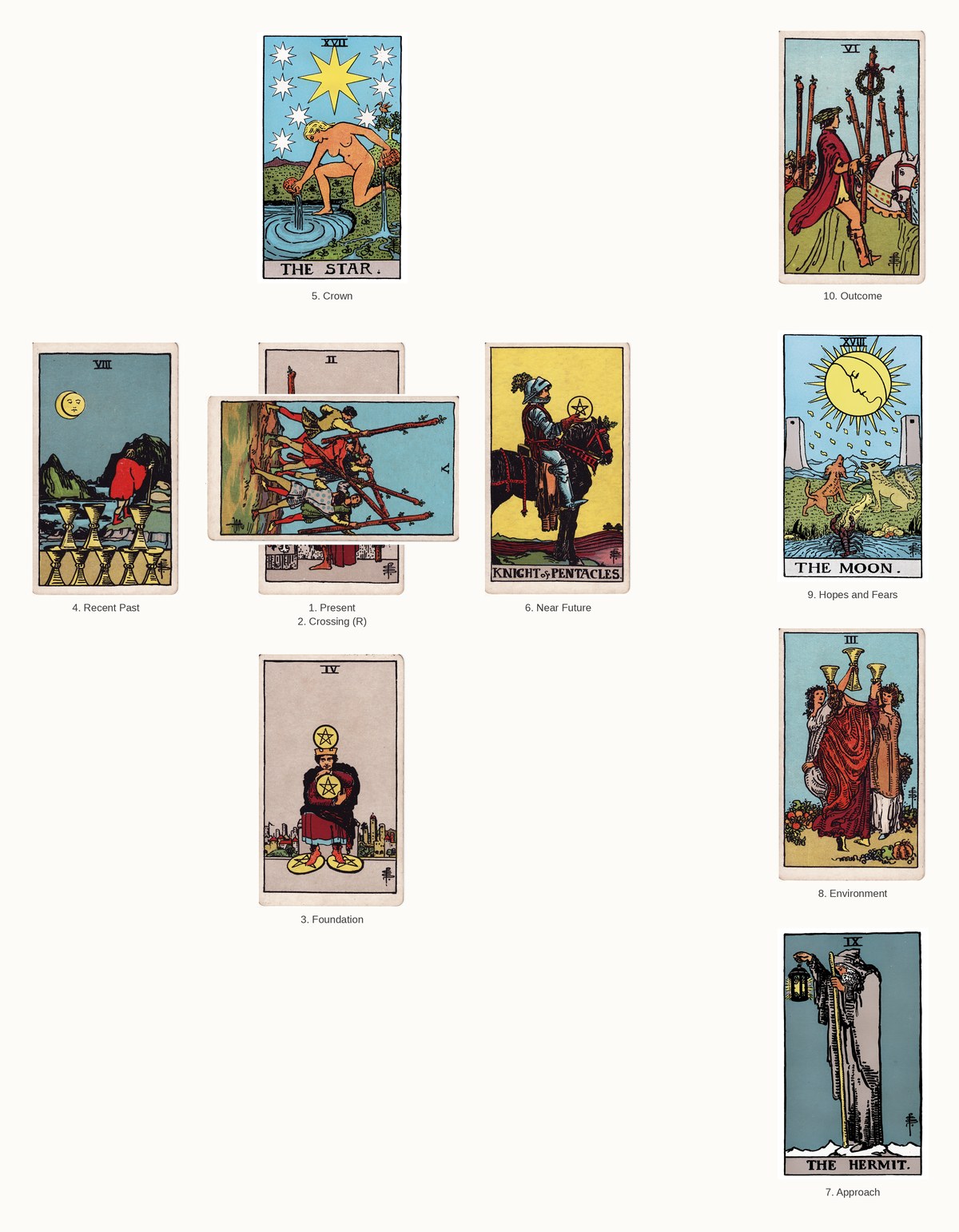
The six cards on the left make the cross. The four on the right make the staff. I read them in three movements.
Where you are: cards 1 to 3
-
The Present. The heart of the matter as it stands today. Everything else in the spread is read in relation to this card.
-
The Crossing. What crosses you. The challenge, the obstacle, or the force pulling against the Present. It is laid sideways across card 1, and the two are always read as a pair.
-
The Foundation. What sits underneath the whole situation. Old patterns, roots, the thing you are standing on that you may not have looked at in years.
What is moving: cards 4 to 6
-
The Recent Past. What is passing away. Something that has been shaping the situation and is on its way out.
-
The Crown. What sits above you. Your conscious aim, what is on your mind, the best that can come of this as things stand.
-
The Near Future. What is coming next. Close, and already on its way.
Where it is heading: cards 7 to 10
-
The Approach. You. How you are meeting all of this, your attitude, the way you are holding yourself.
-
The Environment. The people and the world around you. Family, work, friends, the room you walk into every day.
-
Hopes and Fears. What you want and what you dread. They are often the same thing, which is why they share a card.
-
The Outcome. Where this is heading if nothing changes. Every outcome card is a mirror. If you do not like what you see, the other nine cards show you where to push.
Books do not all number the positions the same way. Waite himself put the Crown third and the Foundation fourth. The meanings are the same, only the order moves, so if you are comparing two books, match the positions by name.
The crossing card: upright or reversed?
People often ask about this, because a card lying on its side does not look upright or reversed.
Waite gave no rule. He said to lay the second card across the first with the words "This crosses him," and wrote that "It shews the nature of the obstacles in the matter." Readers since have settled on three ways of handling it.
-
Read it as it was drawn. Notice whether the card came out upright or upside down before you turn it sideways, and read it that way. This is the most common approach.
-
Always read it upright. The position already means an obstacle, so some readers count a reversal as doubling the problem and ignore it.
-
Go by the direction the top points once the card is on its side. It works only if you always turn the card the same way, and it is the easiest of the three to get wrong.
I use the first. The crossing card is read the way it was chosen, the same as every other card in the spread. Laying it sideways changes its place in the spread and nothing else. If it is reversed, I read it through the same approaches as any other reversed card: blocked, turned inward, too much or too little, or delayed.
In the spreads I send you, you never have to work it out. A reversed crossing card has its top pointing to the right, an upright one to the left, and the caption underneath says "(R)" whenever a card is reversed. In the sample above, the crossing card is the Five of Wands, reversed.
Reading the sample
Here is how I would begin with the sample, as an example of the cards talking to each other.
The Present is the Two of Wands: someone standing on the wall with a globe in hand, weighing up a bigger plan. Across it lies the Five of Wands, reversed. Upright, that card is five people clashing sticks. Reversed, I read it as turned inward: the argument is happening inside the one person, plan against plan, and nobody else can hear it. Beneath them, the Four of Pentacles is holding on tight to what is already safe.
So before I have looked at anything else, the story is a plan that wants to grow, an inner tug of war about it, and an old habit of holding on underneath. The Eight of Cups walking away in the Recent Past and the steady, unhurried Knight of Pentacles in the Near Future start to tell me how it moves.
That is the whole method. Each card on its own, then each card against its partner, then the cross against the staff, until the ten cards are one story.
How I read it
Before a single card goes down, your chart is open beside me: your numbers, your planets, and where the sky is for you right now. The cards are chosen with all of that in view. I call it channelled selection, and it is why the chart and the cards so often say the same thing in two different languages.
Then I write it all down. The spread goes on page two, and every card gets its own section, read in its position, paired with another card, and tied back to your chart where the two meet.
Try it yourself
Lay out a Celtic Cross for a question that matters to you but is not urgent. Something you can sit with.
Before you look anything up, read only the first two cards. What is the situation, and what is crossing it? Write that down in one sentence.
Then lay the rest and see whether they agree with your sentence. More often than you would expect, they do. The first two cards usually tell most of the story.
When a question calls for a smaller spread or a different shape, the Tarot Spreads page has seven more to try.
You will be your own teacher. The positions give you the map, and your own eyes do the reading.
If you would like the Celtic Cross read against your own chart, my readings are here.
The ten positions
The Present
The Present, card 1 of the Celtic Cross: the heart of the matter today. What it asks, how cards read there, and its partner.
Read The PresentThe Crossing
The Crossing, card 2 of the Celtic Cross: what stands in your way, and how I read the sideways card when it comes out reversed.
Read The CrossingThe Foundation
The Foundation, card 3 of the Celtic Cross: the roots under your question, old patterns, and how the card pairs with the Crown.
Read The FoundationThe Recent Past
The Recent Past, card 4 of the Celtic Cross: what is passing out of your life, and how it pairs with the Near Future card.
Read The Recent PastThe Crown
The Crown, card 5 of the Celtic Cross: your conscious aim, the best that can come of this, and how it pairs with the Foundation.
Read The CrownThe Near Future
The Near Future, card 6 of the Celtic Cross: what is already on its way to you, and how it pairs with the Recent Past card.
Read The Near FutureThe Approach
The Approach, card 7 of the Celtic Cross: how you are meeting your situation, and how that card pairs with your Environment.
Read The ApproachThe Environment
The Environment, card 8 of the Celtic Cross: the people and pressures around you, and how that card pairs with your Approach.
Read The EnvironmentHopes and Fears
Hopes and Fears, card 9 of the Celtic Cross: why what you want and what you dread share one card, and how to read it well.
Read Hopes and FearsThe Outcome
The Outcome, card 10 of the Celtic Cross: where things are heading if nothing changes, and why every outcome card is a mirror.
Read The Outcome