It covers much of the ground of the Celtic Cross with three fewer cards, so it is a good choice when a question deserves more than a quick look and you do not have the whole evening to give it. It suits questions with a decision in them: whether to take the job, whether to move house, whether to say the thing you have been holding back.
Where it comes from
Nobody knows who first laid it. One reference site gives its origin simply as "Unknown", and another calls it a classic European spread, without naming a book or a date. What is clear is how widely it is used. Patti Wigington, writing for Learn Religions, calls it "One of the most popular spreads in use today", and adds that "various readers may assign different aspects to the cards in their individual positions."
The layout
Lay the cards in a U, open end at the top. Card 1 goes at the top of the left arm, the cards run down to card 4 at the bottom of the curve, and then climb the right arm to card 7. Some readers turn the whole shape over and lay it as an arch with the open end down. The order and the meanings stay the same either way.
-
The Past. What led here. Something that shaped the situation and is now behind you, though it may still be leaving footprints.
-
The Present. Where things stand today. The other six cards are measured against this one.
-
Hidden Influences. What is working on the situation out of sight. Something you have not noticed, or have noticed and chosen not to look at.
-
Obstacles. What stands in the way. Everything on the right hand side has to get past it.
-
The People Around You. Family, friends, colleagues, and how their attitudes bear on the matter.
-
Advice. What you can do. The one position that speaks directly to your next move.
-
The Likely Outcome. Where the matter lands if nothing about the present course changes.
How to read it
Read the left arm first, then the bottom of the curve, then the right arm.
The left arm, cards 1 to 3, is the situation. Always read card 3 against card 2: the Present is what you can see, the hidden influence is what you cannot, and the gap between them is often why the question got asked.
Then go to card 4, and ask whether cards 3 and 4 are one thing seen from two sides. Quite often the obstacle is the hidden influence working in the open.
The right arm, cards 5 to 7, is the way through. Card 5 tells you who else is in the room. I read card 6 beside card 7, because the advice is how the outcome changes. If you dislike card 7, card 6 is where you put your weight.
Let the position choose the reading for a reversed card. In Hidden Influences it is often turned inward, in Obstacles usually blocked, and in the outcome most often delayed.
Count the Majors as well. One or two in a horseshoe is ordinary. Four or more, and the question is bigger than it looked when you asked it.
A sample reading
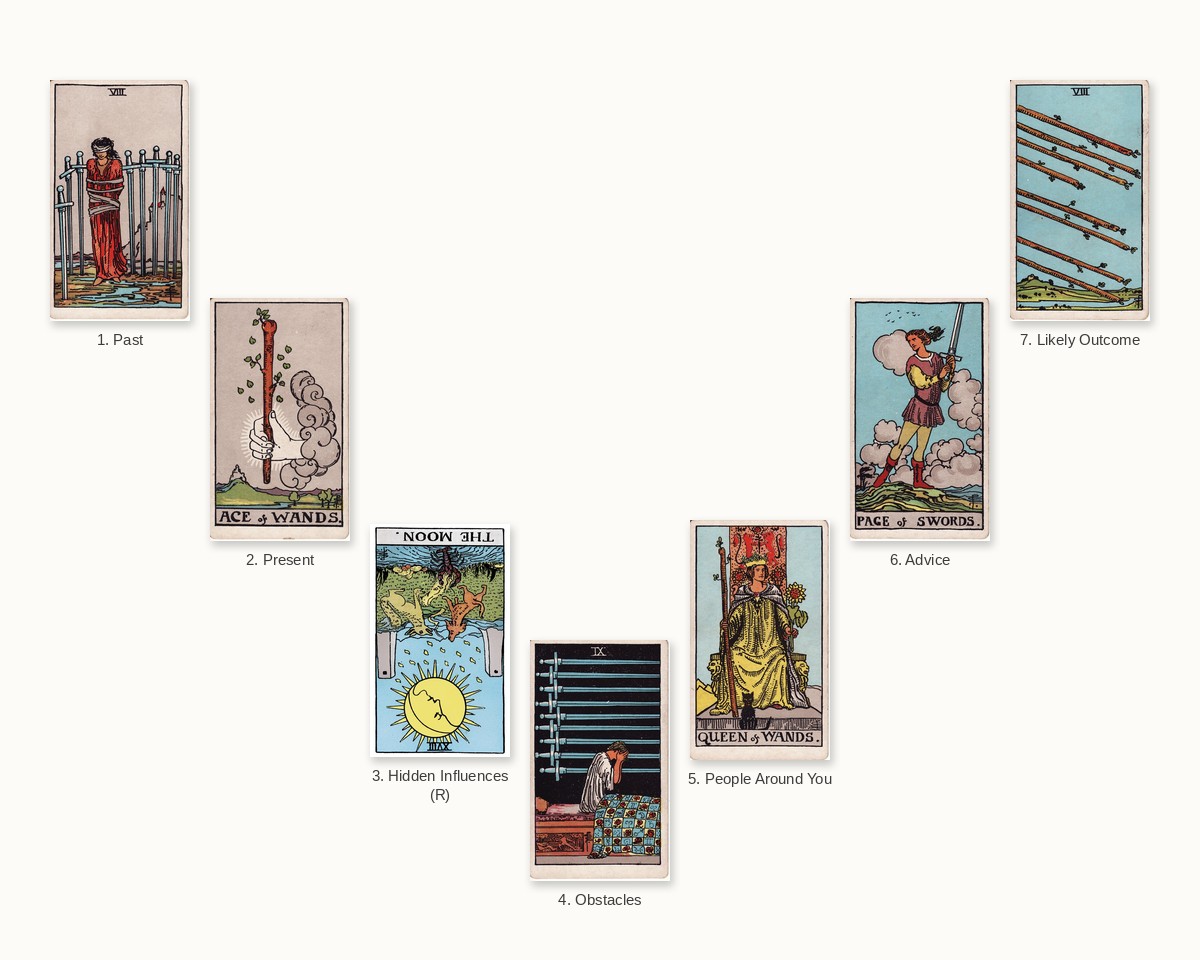
The question: "Should I go back to study this year?" The cards are the ones in the sample spread above.
The Past is the Eight of Swords: a woman bound and blindfolded, with eight swords planted in the ground around her. The swords make a fence with gaps in it. This person has felt stuck for a while, and much of it was in how they saw their own position.
The Present is the Ace of Wands, a hand coming out of a cloud holding a living branch with leaves sprouting from it. A new spark, and because it is fire, it wants to be acted on. Against the Eight of Swords, the story so far is someone who has been sitting still and has just felt the pull to move.
Hidden Influences holds the Moon, reversed. Upright, it is a path between two towers at night, a dog and a wolf howling, a crayfish crawling out of a pool: fear, and the things that look bigger in the dark. Reversed, I read it as turned inward: the doubts are being kept private. Nobody else knows how unsure this person feels, so nobody has answered those doubts.
That runs straight into card 4. The Nine of Swords is a figure sitting up in bed at night, head in hands, nine swords on the dark wall behind. The obstacle is the worry itself, the three in the morning version of the question. The Moon reversed and the Nine of Swords say the same thing twice, once quietly and once loudly. When two cards agree like that, I take notice.
Card 5, the people around: the Queen of Wands, on her throne with a sunflower in her hand and a black cat at her feet. Someone close already believes this person can do it, and the support at home is stronger than the worry admits.
Card 6, the advice: the Page of Swords, standing on high ground with his sword raised and wind pushing the clouds behind him. A Page is a student, and Swords are questions. The advice is to go and find out. Ring the college, read the course outline, and ask out loud the questions the Moon has been keeping in the dark.
Card 7, the likely outcome: the Eight of Wands, eight branches flying through clear air. Once this starts moving, it moves quickly.
Put together, the horseshoe says the spark is real, the obstacle is mostly the night time worry, there is support close by, and the step that clears the way is a practical one. The only Major sits in the hidden position, which tells me the large thing here is happening inside the person.
Variations
The most common difference between books is card 4. Patti Wigington makes it the person asking the question, and moves the obstacle out of the spread altogether. Another popular version runs the Past, the Present, the Near Future, the Answer, the Surrounding Energy, Hopes and Fears, and the Outcome, and the site that teaches it calls it a variation of the Celtic Cross.
All of them work. Choose one before you shuffle and keep to it until you know it well.
Try it yourself
Lay the horseshoe for a question with a decision in it, then cover cards 5, 6 and 7 with your hand.
Read only the left arm and the card at the bottom of the curve, and write one sentence about what is holding you back.
Then take your hand away and ask whether the advice card answers your sentence. If it does, you have read a horseshoe. If it does not, go back to card 3. The missing piece is usually hiding there.
If you would like the cards read against your own chart, my readings are here.