
It works for a partner, and just as well for a friendship, a sister, a parent, a business partner, or the colleague you cannot work out.
A word first about the other person. A spread you lay, about someone who is not in the room, shows your side of the connection and your sense of them. It cannot open their private thoughts, and it was never built to. Ask it what someone is doing behind your back and the cards will usually show you your own worry, which is worth looking at as well.
Where it comes from
There is no single relationship spread. Every teacher seems to have their own. Labyrinthos publishes three on one page, with three, five and seven cards, and another widely shared seven card version is built largely around how each person sees the other. I could not find a first author or an early book for any of them. Treat the version on this page as one workable shape among many.
The layout
Lay card 1 on the left and card 2 on the right, level with each other, with a gap of about two card widths between them. That is your side and their side. The five shared cards go down the middle, in the gap, from card 3 at the top to card 7 at the bottom.
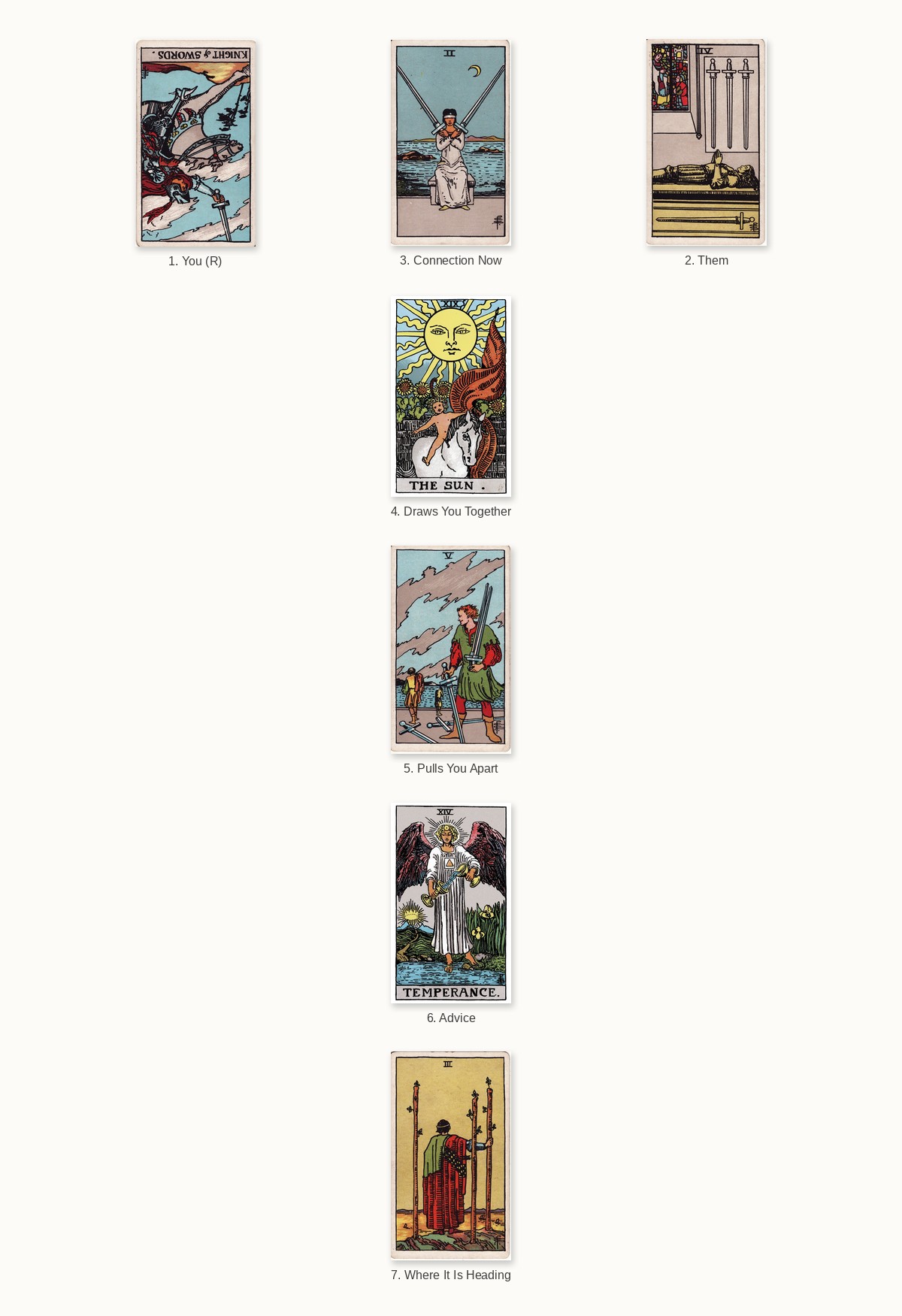
-
You. How you are in this connection right now: what you bring, and how you are holding yourself.
-
Them. The other person as you experience them. Read it as your view of them, which may or may not match how they see themselves.
-
The Connection Now. The relationship itself as it stands today, the thing the two of you make together.
-
What Draws You Together. What holds you close, what each of you finds in the other, the reason this connection exists at all.
-
What Pulls You Apart. The friction, the distance, the pattern that keeps getting in between.
-
Advice. What you can do. It speaks to your side, because your side is the one you can change.
-
Where It Is Heading. The direction the connection is moving if both of you carry on as you are.
How to read it
Start with cards 1 and 2, side by side, before you look at anything else. Ask how the two people in this connection differ and how they are alike. Look at the suits: a Wands card beside a Cups card is fire beside water, and the How to Read a Card page shows what each element brings.
Then read card 3 and ask how it grows out of the first two.
Cards 4 and 5 are a pair. What draws two people together and what pulls them apart are often the same quality, seen in good light and in poor light. The steadiness you love in someone can be the same steadiness that drives you to distraction on a bad day.
Read card 6 and card 7 together. The advice is how the direction shifts.
Reversed cards are useful here, because most friction between people is a quality turned up too high or down too low. In cards 1 and 2, a reversal is often too much or too little, or turned inward. In card 7 it is usually delayed.
Majors carry weight in this spread. A Major in card 3, 4 or 5 says the connection is carrying a bigger lesson for both of you. A Major in card 1 or 2 puts that lesson on one person.
A sample reading
The question: "Where are my partner and I heading?" The cards are the ones in the sample spread above.
Cards 1 and 2 first. The Knight of Swords is a rider at full gallop, sword raised, his horse straining forward into the wind. Upright, he is quick and direct. Reversed, I read him as too much: words arriving faster than thought, pressing for an answer before the other person is ready. Beside him, the partner appears as the Four of Swords, a knight lying still on a tomb with his hands together, three swords hanging above him and one beneath. Rest, retreat, recovery.
Both people live a good deal in their heads. One wants to talk it all through tonight, and the other needs quiet before they can talk at all. Remember this is the asker's view: the Four of Swords is how the partner looks from here.
Card 3, the connection, is the Two of Swords: a woman sitting blindfolded with two swords crossed over her chest and the sea behind her. A standoff, a decision both are putting off. Three Swords out of three: so far it is all thoughts and words, with very little feeling said out loud.
Then the Sun in card 4, and the spread warms up. A child rides a white horse under a huge sun, with sunflowers along the wall behind. What draws these two together is plain joy in each other's company. It is a Major, so the bond has real weight.
Against it, in card 5, sits the Five of Swords: a man gathering up swords with a half smile while two figures walk away from him. Arguments one person wins and both lose. The joy is real, and so is the habit of needing to be right.
The advice, card 6, is Temperance: an angel pouring water from one cup into another, one foot on dry land and one in the water. Beside the Knight reversed, it reads almost as an instruction: slow down, and pour back and forth until the two cups hold the same water.
Card 7 is the Three of Wands: a figure on a cliff with his back to us, watching ships out at sea. The connection is heading towards a shared future, if both people let the ships come in at their own pace.
Pulled together: one person rushing, the other resting, a standoff, real warmth underneath, an old habit of point scoring, and advice to slow down. The advice speaks to the person who laid the cards, which is where it belongs.
Variations
-
Three cards. You, them, and the connection, laid left to right with the connection in the middle. Labyrinthos lays it as you, the dynamics, and your partner.
-
How you see each other. A popular seven card version pairs how you see yourself and how you see them with how they see you and what they feel about you. If you use it, read the positions about the other person as your own sense of them, with the same care as above.
-
Beyond romance. For a friend, a parent or a business partner, keep the seven positions and change only the question.
Try it yourself
Lay the spread for a connection that is going well. It is far easier to see the cards clearly when nothing much is at stake.
Read only cards 4 and 5 first, and find the single quality that sits underneath both of them.
Then turn to card 6 and ask how the advice would change that quality.
If you would like the cards read against your own chart, my readings are here.